October 2026 Stellar Spotlight story
Building community through dance
By Rod Jones, OCU Marketing & Communications
Just four years out of college, Oklahoma City University dance alumna Darci Heavner was presented with a unique opportunity: Fulfill her dreams of purchasing the studio where she learned to dance as a child.
Just one problem – she would need to go to the bank for financing and take on full day-to-day operations at the studio, including managing enrollment, parent communications, costumes, marketing and every other aspect of running a dance business.
Fortunately, Heavner had an ace up her sleeve. Her preparation at the Ann Lacy School of American Dance and Entertainment – specifically her work at the school’s Community Dance Academy – had her ready to win over the bank and take over the studio on day one.
Since its establishment in 2007, the Community Dance Academy (CDA) has operated as the launching pad for many careers in dance, not only for performers and managers, but also for teachers. While the Ann Lacy School of American Dance and Entertainment is globally renowned for producing Broadway performers and precision stage dancers, the CDA extends the school’s purpose in two ways: by providing accessible, high-quality dance education to the greater Oklahoma City area, and by acting as a learning laboratory for future dance teachers and studio managers.
Classes are held for age groups from 3 years old through adulthood. On any given Saturday inside the CDA’s home in Studio Q, you might see a group of 3-year-olds on one side of the room, some in light pink leotards, others in white T-shirts and black sweatpants, all wearing tap shoes as they navigate a world of rhythm, motor skills and body awareness. On the other side is an undergraduate dance teacher major, learning how to command a room, manage classroom dynamics and inspire confidence.
Theory applied
No one exemplifies this pipeline better than Heavner, who graduated with a Bachelor of Science degree in American Dance Pedagogy in 2017. Heavner is now the owner of the S&S School of Dance in Pittsfield, Illinois.
Even before college, Heavner’s dream was to purchase S&S, the childhood studio where she originally learned to dance. While honing her teaching skills under the one-way mirrors of OCU’s Studio Q, she also held a student work-study job as the CDA’s office manager during her junior and senior years.
“I not only was making phone calls to parents, I was having conversations with them in the lobby that really increased my comfort and my confidence when it came to teacher-parent communication,” Heavner recalled. “I really don't know what it would be like taking over a studio if I hadn’t had that hands-on experience, especially when it came to dealing with parents and just that whole other side of a dance studio — putting together communications for recitals, picture day, costume fittings and monthly newsletters.”
After graduating, Heavner spent three years serving as the director of an Oklahoma City public high school dance program. In 2020, she moved back to Illinois. When the owner of her childhood studio decided to retire in early 2021 amidst the COVID pandemic, Heavner stepped in. She purchased the studio and had classes up and running within two weeks.
When she went to the bank for financing, she didn’t have to start from scratch. She pulled out the massive business plan she had constructed during her senior spring at OCU, one of the requirements of the capstone Dance Studio Management class.
“I used it a lot,” Heavner said. “When I went to the bank to get funding to purchase the studio, I pulled so much from that. Whether it was the financial layout, the budgeting, or just the business plan in general of what I wanted it to look like on my terms. It really opened my eyes to the true value and cost it was going to take to operate, but I was able to just replace my college assignment with my actual real-world numbers.”
Studio Q as live classroom
In many university dance programs, pedagogy — the art and science of teaching — is taught theoretically from textbooks or through observation. Students graduate with dance degrees only to face a steep learning curve when they step in to lead a real classroom or studio for the first time.
At OCU, the CDA closes that experience gap by bringing the community directly onto campus. The academy caps total enrollment at roughly 130 students. This limit maintains small class sizes of seven to 12 students, ensuring young dancers receive personal attention to build confidence while pedagogy majors gain consistent, hands-on teaching experience without overwhelming the children with rotating instructors.
“Some dance schools combine age groups in a way that you may have a 3-year-old in class with a 5-year-old,” CDA Director Tiffany Warford said. “At the CDA, we separate young students to ensure the best classroom environment for dancers and teaching environment for our pedagogy majors. Three- and 4-year-olds are an interesting group of little humans. You have to know how to interact with them and how the studio environment works to ensure a successful class.”
While university programs often rotate student teachers, the CDA recognizes that young children thrive on routine and consistency.
“Assigning teachers to the class schedule is a painstaking process,” Warford explained. “In order to keep a routine for our young dancers, pedagogy students are assigned to a set of classes in the fall and then rotate in the spring semester. This allows you to have balance and consistency within the learning environment.”
To provide real-time mentorship without disrupting the children, Studio Q is equipped with specialized tools for faculty observation and feedback:
- One-way mirror: University professors observe college student instructors from behind a one-way mirror, taking notes on classroom management and lesson execution.
- Video playback and lesson plans: Undergraduate instructors submit structured lesson plans each week. Classes are often recorded so faculty can review them with students later, breaking down how to better handle management issues or celebrate breakthrough moments.
- Digital accessibility: Following the COVID pandemic, the academy implemented livestreams via the Band app, allowing parents to watch from the lobby or from home and enabling sick students to observe classes remotely.
Breaking barriers
Dance classes can be expensive, often excluding families who cannot afford monthly tuition, costume fees and recital tickets. Dance school leaders hope to remove those financial walls.
Participation in the academy’s annual showcase comes at zero cost to students. There are no recital fees, no costume purchase requirements, and tickets to the final performance are free for families and friends. Furthermore, through generous donor support and internal funding, the CDA offers scholarship assistance to qualifying families who are enrolled in public school reduced-lunch programs, as well as grants for homeschooled children.
This commitment to accessibility has turned Studio Q into a neutral ground, where children from different socioeconomic and technical backgrounds dance side-by-side.
“Our teachers are unaware of which students are receiving scholarship assistance. They are there to share their love of dance and instill a love of the arts to all of our students,” Warford noted. “Our classes are a cool mix of students, and they learn from each other because they come from different backgrounds, different schools, and sometimes different circumstances.”
From stage to studio
The Community Dance Academy’s growth has mirrored strategic shifts within OCU’s university curriculum, notably by having students take a “universal dance” foundational track their first two years.
Rather than forcing incoming freshmen to declare a specialized major at age 18, all OCU dance students spend their first two years taking introductory courses across all tracks: performance, management and pedagogy.
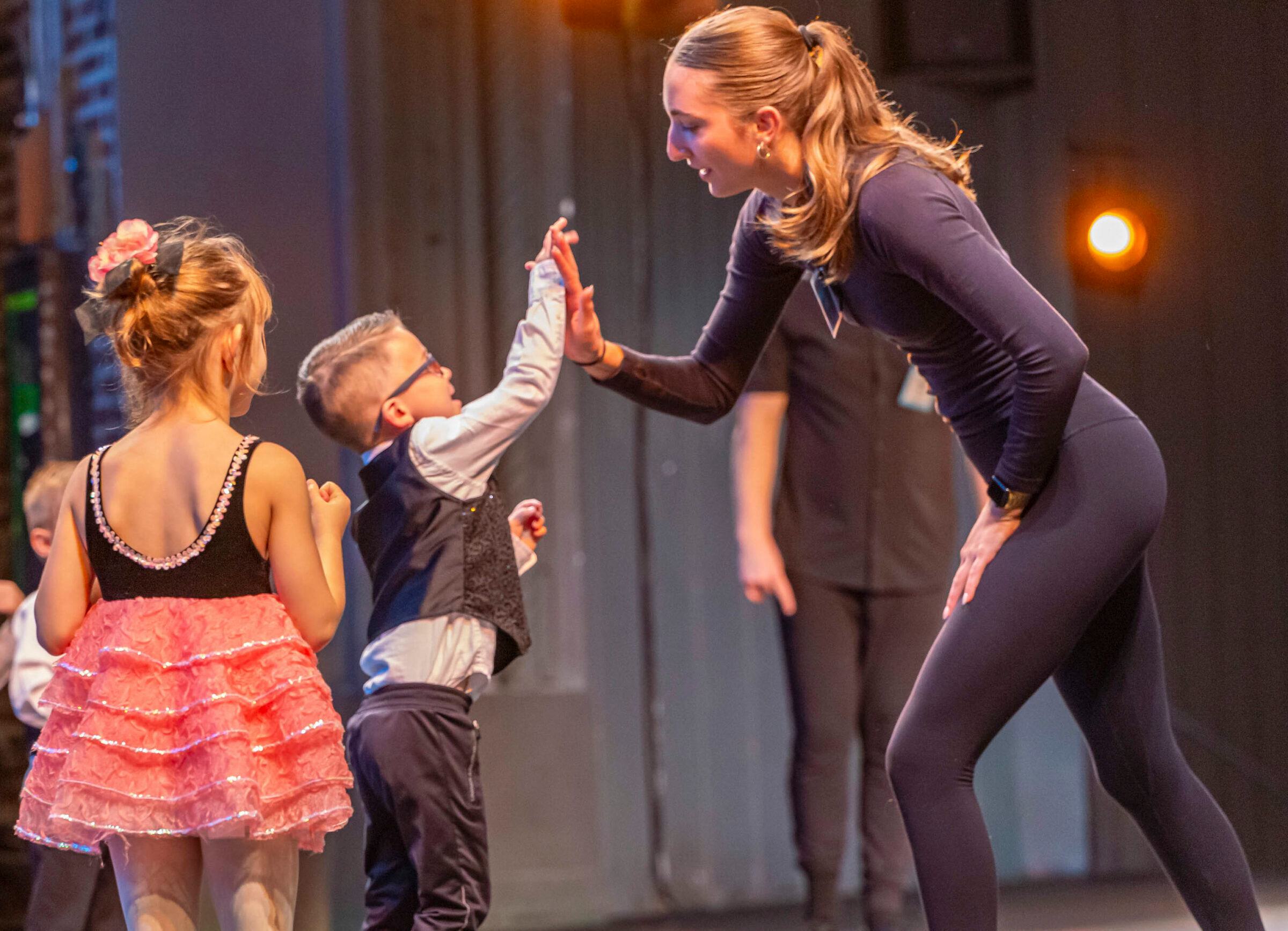
“Typically, our students come from a commercial studio that may include a dance competition background. They were always the ones onstage,” Warford noted. “They may not have had the opportunity to participate in the technical, teaching or leadership side of dance. Now, the two-year track helps them see this side of dance. Some take the intro to teaching class and discover, ‘I’m good at teaching and I like it!’ It has really helped our American Dance Pedagogy program grow.”
By shifting pedagogical teaching labs to evenings and weekends, university students can also audition for major campus productions like “MOVE!” while actively teaching diverse age groups and styles from ballet and tap to jazz and hip-hop.
Proof of concept
Perhaps the most remarkable byproduct of the Community Dance Academy is what happens when OCU students reach their senior year. In their capstone class, pedagogy and management majors spend a semester building a comprehensive business plan for a hypothetical dance studio. The plan covers everything from bank financing and building logistics to marketing and student recruitment.
Armed with a year of practical teaching experience in Studio Q and a tested business blueprint, many alumni achieve what is virtually unheard of in the arts industry: opening their own brick-and-mortar studios in their mid-20s.
“Many people would not be able to open a dance studio at 25 because they don’t know how to fund it, build it, recruit for it or market it,” Warford explained. “But these graduates are able to take that project, adjust it, and literally open a dance studio.”
Positive influencers
A significant number of graduates have become the driving force behind dance education in the Oklahoma City Public Schools district, which offers dance programs across its middle and high schools. They lead daily, credit-bearing dance classes at schools during the day, while continuing to teach advanced competition classes at private local studios in the evenings.
“As freshmen, if I asked pedagogy majors if they would be interested in teaching at a metropolitan public school, many would not say yes,” Warford said. “But after they have this experience in the CDA, it opens their eyes. They are helping children that, without our scholarship program, may not be able to attend dance class. This means a lot to our CDA families and can have a positive effect on the dancers. This changes our pedagogy majors’ outlook and they become interested in helping teach dance to communities that may not otherwise have the opportunity.”
Whether an OCU student graduates to perform on a Broadway stage, direct a high school arts program, open a commercial studio, or manage sports entertainment, the foundation of their professional confidence can be traced back to a single room in the Edith Kinney Gaylord Center.
And for the local toddler putting on her first pair of ballet shoes, or the middle schooler finding a safe harbor, it is simply a place where they are seen, challenged and celebrated.
When asked what advice she would give her younger self looking back through the viewing glass of Studio Q, Heavner reflects on the ultimate lesson of the academy.
“I would tell myself to believe in myself, that it’s all worth it, and that what I have to offer matters,” she said. “No matter how big or small my class is, no matter how big or small my studio is, I’m going to make a difference in the lives of others. There’s no reason to doubt my training or the product I have to offer my community.”