Retirement community writing workshops foster learning
BY ROD JONES
OCU COMMUNICATIONS
At the Epworth Villa senior living community, the writing workshop doesn't follow a syllabus. There are no frantic students pulling all-nighters or grading rubrics. Instead, there is what Oklahoma City University English professor Rob Roensch calls a "meaningful, ceremonial sharing."
For Roensch, who has led the bi-weekly workshop since approximately 2017, the initial transition from the university classroom to the retirement community required a shift in perspective. He arrived with the standard academic toolkit of exercises, prompts and lesson plans, only to find that his new "students" had a very different agenda.
"I sort of assumed it would be like an undergraduate class," Roensch said. "But that’s really not what they wanted. They have whole lives to share. They want to write on their own time and share it with each other. They just want me there to listen and give some feedback."
The Write Group workshops, as they’re formally known, started several years before Roensch’s arrival. Epworth Villa resident and former OCU trustee Burrel McNaught and his wife, JoAnn, led the meetings before recruiting the English professor for his expertise. McNaught, who was awarded an honorary doctorate in divinity from the university in 1985, has continued as a regular attendee and contributor ever since. (McNaught’s wife and daughter earned education degrees from OCU.)
The workshops have deepened the connections between OCU and the retirement community which, like the university, has several strong connections with the Oklahoma Conference of the United Methodist Church.
Late-season blooms
Among those sharing their work during a recent Write Group session was Kae Koger, a retired University of Oklahoma theater history professor. Having spent 29 years in the rigorous world of academia, Koger found herself in "writer mode" following her retirement in 2020. She initially worked on a memoir based on her parents’ World War II letters, a project that eventually toured as a play, but the workshop has pushed her into uncharted territory: fiction.
"This is the first time I’ve ever written anything where I invented stuff," Koger said. Her current project is a novel set in 1970s Louisville, featuring a protagonist heavily influenced by the works of Tennessee Williams. "I could not have imagined myself doing that 10 or 15 years ago."
For Koger, the workshops provide a specific kind of freedom. There is no editorial board to please and no tenure track to satisfy. Yet the presence of an academic expert like Roensch provides a vital anchor.
"It’s the difference between writing for publication where you don't know how it will be received, and something like this where the feedback stimulates more ideas," she explained.
Bridging generations
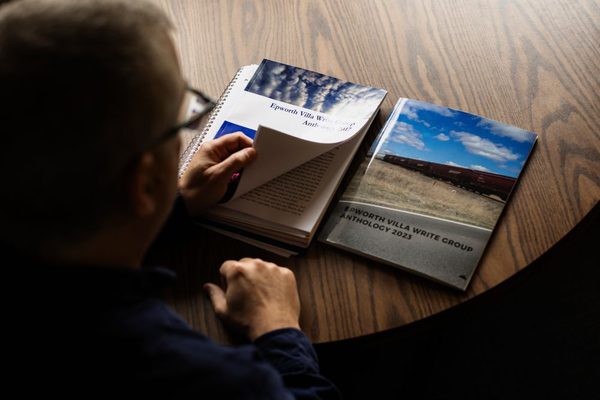
The connection between OCU and Epworth isn't just a solo act by Roensch. It has become a bridge between generations. In 2023, Roensch integrated his Writing for Editing and Publishing college class into the workshop’s ecosystem. The OCU students took on the roles of proofreaders and organizers, helping the residents compile their work into an anthology published via Lulu, then distributed around the Epworth Villa campus.
This collaboration turns the residents' life stories into tangible legacies. Whether it’s a retired minister like McNaught, who has written several collections of his own work, or a former small-town reporter documenting the history of racial prejudice, the workshop validates their experiences as literature.
The impact of the workshop often spills out into the hallways of the community. Koger recalls helping another resident navigate the world of self-publishing for his 300-page novel.
"Everybody really has a literary voice," Koger notes. "It’s so much more fun when you don't have to do it, but now you want to."
For Roensch, the takeaway is simple. He views himself less as a lecturer and more as a participant who brings poems he loves to share with a group of peers.
"I think being a teacher is about listening to the things that people bring to you," Roensch said. "It’s just a very straightforward, honest exchange of ideas and words. It should be meaningful at all stages of life."
Kroger, who has been attending the workshops since becoming a resident in late 2023, said her favorite aspect is getting to know other residents more intimately.
“It’s a benefit I hadn’t really thought of before I started coming,” she said. “These discussions have been the best way to get to know people.”